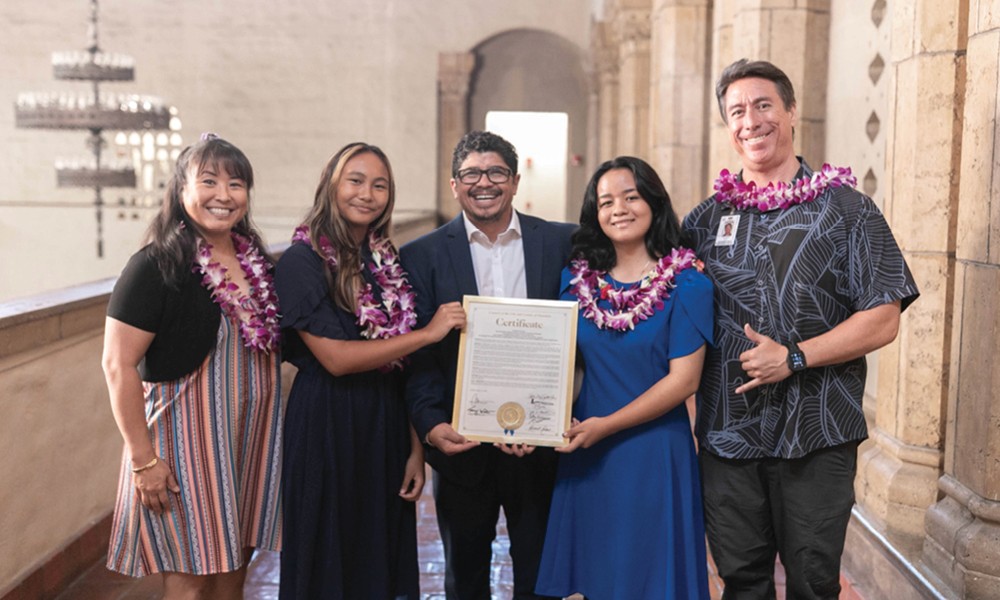
A U.S. Marine Corps veteran, teacher, inventor, scientist, engineer, nonprofit founder, environmental advocate, and aspiring architect, Ray has made it his mission to protect Hawaiʻi's natural beauty while inspiring others to do the same.
After serving as a Combat Engineer and Non-Commissioned Officer in the U.S. Marine Corps from 2009 to 2017, Ray turned his focus to environmental conservation and community service. In 2018, he founded SEED (Stimulating Education and Ecological Design), a nonprofit dedicated to environmental education, marine debris removal, microplastic research, and developing innovative tools that make it easier for communities to take action.
Ray proudly "talks trash" wherever he goes. His engaging presentations teach children and adults about marine debris, microplastics, recycling, and reusing materials in fun, hands-on ways that inspire action. From kindergarten classrooms to college lecture halls and community events, Ray encourages people of all ages to become environmental stewards, proving that small actions can create meaningful change.
A U.S. Marine Corps veteran, teacher, inventor, scientist, engineer, nonprofit founder, environmental advocate, and aspiring architect, Ray has made it his mission to protect Hawaiʻi's natural beauty while inspiring others to do the same.
After serving as a Combat Engineer and Non-Commissioned Officer in the U.S. Marine Corps from 2009 to 2017, Ray turned his focus to environmental conservation and community service. In 2018, he founded SEED (Stimulating Education and Ecological Design), a nonprofit dedicated to environmental education, marine debris removal, microplastic research, and developing innovative tools that make it easier for communities to take action.
Ray proudly "talks trash" wherever he goes. His engaging presentations teach children and adults about marine debris, microplastics, recycling, and reusing materials in fun, hands-on ways that inspire action. From kindergarten classrooms to college lecture halls and community events, Ray encourages people of all ages to become environmental stewards, proving that small actions can create meaningful change.

Ray has started his own non-profit called SEED that partners with local organizations to help educate community. Photo: Ray Aivazian III
His enthusiasm is contagious. Volunteers of all ages regularly join the cleanups he organizes across Oʻahu. Some events remove thousands of pounds of marine debris from beaches, while others focus on collecting tiny microplastics hidden in the sand and ocean. Every cleanup is also an opportunity to educate participants about protecting Hawaiʻi's fragile ecosystems and empower them to become lifelong environmental advocates.
Ray's commitment to conservation extends far beyond community cleanups. He helped charter the Windward Community College chapter of the Surfrider Foundation and later served as vice chair and chair of the Oʻahu Chapter, expanding volunteer opportunities and community partnerships across the island. Since 2019, he has also collaborated with Hawaiʻi Pacific University's Center for Marine Debris Research, contributing to research that advances the understanding of marine debris and microplastic pollution.
Innovation is another hallmark of Ray's work. Through SEED, he has developed open-source tools that help scientists and volunteers better identify and study microplastics. One of his most creative inventions, nicknamed the "Trash Time Machine," speeds up the separation of plastic from natural materials, making environmental education both engaging and accessible. By freely sharing these designs, Ray empowers researchers, educators, nonprofits, and community organizations around the world to improve cleanup efforts and advance scientific research.
His enthusiasm is contagious. Volunteers of all ages regularly join the cleanups he organizes across Oʻahu. Some events remove thousands of pounds of marine debris from beaches, while others focus on collecting tiny microplastics hidden in the sand and ocean. Every cleanup is also an opportunity to educate participants about protecting Hawaiʻi's fragile ecosystems and empower them to become lifelong environmental advocates.
Ray's commitment to conservation extends far beyond community cleanups. He helped charter the Windward Community College chapter of the Surfrider Foundation and later served as vice chair and chair of the Oʻahu Chapter, expanding volunteer opportunities and community partnerships across the island. Since 2019, he has also collaborated with Hawaiʻi Pacific University's Center for Marine Debris Research, contributing to research that advances the understanding of marine debris and microplastic pollution.
Innovation is another hallmark of Ray's work. Through SEED, he has developed open-source tools that help scientists and volunteers better identify and study microplastics. One of his most creative inventions, nicknamed the "Trash Time Machine," speeds up the separation of plastic from natural materials, making environmental education both engaging and accessible. By freely sharing these designs, Ray empowers researchers, educators, nonprofits, and community organizations around the world to improve cleanup efforts and advance scientific research.

Ray's work and advocacy started when he became one of the first volunteers of the City and County of Honolulu's Adopt-a-Park Program. Photo: Ray Aivazian III
Ray's passion for serving his community also led him to become the first volunteer to join the City and County of Honolulu's Adopt-a-Park Program. Today, he helps care for Keʻehi Lagoon Beach Park through Doris Miller Lodge No. 6, Neil S. Blaisdell Park through the NAACP Hawaiʻi Environmental and Climate Justice Committee, and Kalama Beach Park through SEED. Together with volunteers, these organizations remove litter, beautify public spaces, and restore parks for the entire community to enjoy.
"The process was so simple," Ray said. "I picked a park, filled out a short application, and committed to helping care for it. If you care about your community, adopt a park and get started. It's one of the easiest ways to make a lasting difference."
Ray believes lasting environmental change begins with education and teamwork. "We believe that through education and teamwork, we the people can rehabilitate our world and create the positive change we all want to see."
He has seen firsthand how one conversation can spark a movement. After one of his "Trash Talk" presentations at Maunawili Elementary School, kindergarten students created their own plans for protecting Hawaiʻi's oceans, taking what they learned home to their families and inspiring others to care for the environment.
Ray's passion for serving his community also led him to become the first volunteer to join the City and County of Honolulu's Adopt-a-Park Program. Today, he helps care for Keʻehi Lagoon Beach Park through Doris Miller Lodge No. 6, Neil S. Blaisdell Park through the NAACP Hawaiʻi Environmental and Climate Justice Committee, and Kalama Beach Park through SEED. Together with volunteers, these organizations remove litter, beautify public spaces, and restore parks for the entire community to enjoy.
"The process was so simple," Ray said. "I picked a park, filled out a short application, and committed to helping care for it. If you care about your community, adopt a park and get started. It's one of the easiest ways to make a lasting difference."
Ray believes lasting environmental change begins with education and teamwork. "We believe that through education and teamwork, we the people can rehabilitate our world and create the positive change we all want to see."
He has seen firsthand how one conversation can spark a movement. After one of his "Trash Talk" presentations at Maunawili Elementary School, kindergarten students created their own plans for protecting Hawaiʻi's oceans, taking what they learned home to their families and inspiring others to care for the environment.

You can learn more about Ray and his organization SEED by checking out their instagram @seed.world. Photo: Ray Aivazian III
Today, Ray is studying architecture at the University of Hawaiʻi at Mānoa, where he hopes to combine environmental science, engineering, and community-centered design to create stronger, more resilient, and more sustainable communities.
Ray says the same spirit of teamwork is what makes the City's Adopt-a-Park Program so successful. "If every neighborhood had a few people willing to step up, the impact across our island would be incredible," he said. "I encourage anyone who's interested to consider adopting a park and becoming part of that positive change."
How You Can Help
The City and County of Honolulu's Adopt-a-Park Program makes it easy for individuals, families, businesses, schools, churches, and community organizations to care for neighborhood parks. Volunteers can organize a one-time cleanup or adopt a park for months or even years, helping pick up litter, rake leaves, remove graffiti, paint benches, and beautify public spaces.
To learn more about the Adopt-a-Park Program, visit honolulu.gov/parks or call (808) 768-3034.
Today, Ray is studying architecture at the University of Hawaiʻi at Mānoa, where he hopes to combine environmental science, engineering, and community-centered design to create stronger, more resilient, and more sustainable communities.
Ray says the same spirit of teamwork is what makes the City's Adopt-a-Park Program so successful. "If every neighborhood had a few people willing to step up, the impact across our island would be incredible," he said. "I encourage anyone who's interested to consider adopting a park and becoming part of that positive change."
How You Can Help
The City and County of Honolulu's Adopt-a-Park Program makes it easy for individuals, families, businesses, schools, churches, and community organizations to care for neighborhood parks. Volunteers can organize a one-time cleanup or adopt a park for months or even years, helping pick up litter, rake leaves, remove graffiti, paint benches, and beautify public spaces.
To learn more about the Adopt-a-Park Program, visit honolulu.gov/parks or call (808) 768-3034.
Cover Photo:
Ray has been a lifelong advocate and educator on issues affecting parks and our oceans. Photo: Ray Aivazian III
Cover Photo:
Ray has been a lifelong advocate and educator on issues affecting parks and our oceans. Photo: Ray Aivazian III
Category Tag:
Share this story
Subscribe to the District 9 mailing list
Receive mid-month and end of month updates, sent directly to your email!